
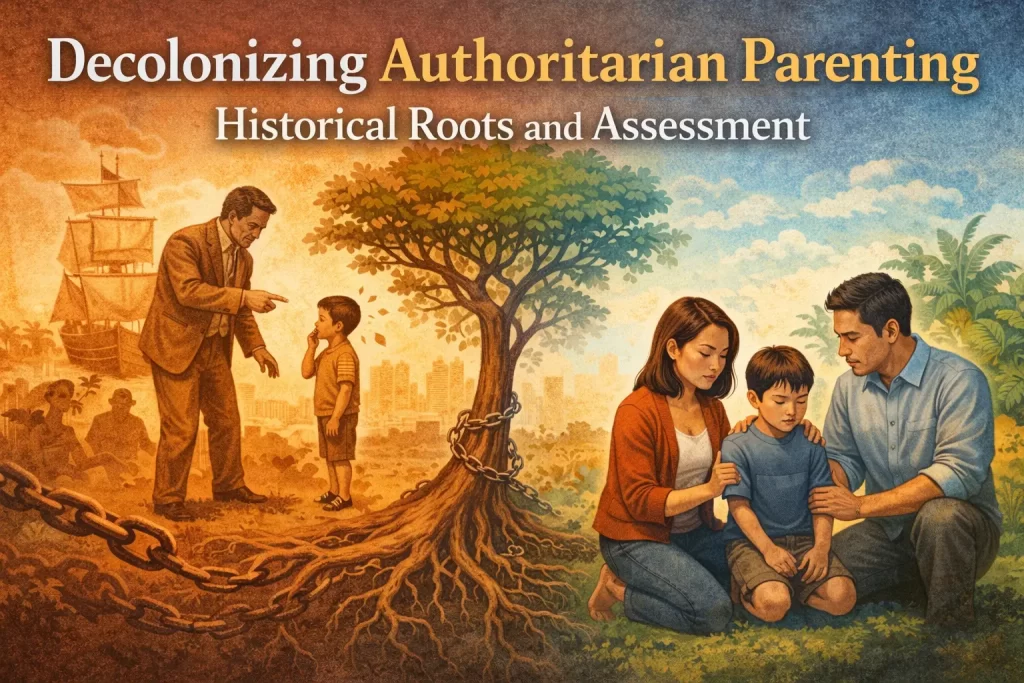
Authoritarian parenting in many Asian families—whether in India, Vietnam, China, Korea, the Philippines, or here in Dublin and Pleasanton, CA—may not have simply come from “culture.” Many of these dynamics can be traced to the effects of colonization, poverty, and generations of survival and the trauma of war and colonization (Fanon, 1961/2004). In this article, we will discuss and connect those historical roots to what you may see in your family today and explore how working with a local therapist in Dublin, CA or a therapist in Pleasanton, CA can support more nurturing ways of parenting.
Why Authoritarian Parenting Is About History, Not Just “Asian Culture”
As an Asian therapist, Vietnamese therapist, and clinical psychologist practicing in the local area, I often meet with a diverse range of Asian clients in the Dublin, Pleasanton, Livermore, San Ramon, Castro Valley, and Danville area. Many of my clients were raised in families with traditional values and often share similar memories of childhood when interacting with their parents. For example, many report being told or received messages of:
- “Do as I say.”
- “Don’t talk back.”
- “Feelings are weak.”
- “Why are you so stupid?”
- “Your friend is doing well, why can’t you?”
- “Other people’s children are successful, why aren’t you?”
- “Why can’t you be like other kids?”
This often gets labeled as “Asian parenting,” but authors like Frantz Fanon, who studied the psychology of colonized people, show that it’s deeply tied to colonial violence, rampant fear, and total control (Fanon, 1961/2004). Colonized families often lived with:
- Unpredictable rules from those in power
- Humiliation and racism
- Real consequences for “stepping out of line”
In that world and colonized society where any mistake can result in a serious punishment or death sentence, strict parenting could feel like protection and doing what’s best to save your children. If your parents or grandparents believed that only obedience and excellence kept you safe, it’s likely because that’s what they themselves had to learn in order to survive. This is a common theme that comes up in my work providing therapy in Dublin, therapy in Pleasanton, and therapy in Livermore areas.
How Colonization Changed Family Life in Asia
Losing the Extended Family Safety Net
Before colonization, many Asian families didn’t raise children alone. Grandparents, aunties, uncles, neighbors, and village elders all helped guide and care for kids. That shared caregiving helped balance out any one person’s stress or strictness.
Research on Indigenous and community-based child-rearing shows that children thrive when they are surrounded by a web of caring adults, not just one or two overwhelmed parents (Ullrich, 2019).
Colonial forces tend to specifically target and weaken these bonds by:
- Forcing people off their land for plantations or military projects
- Pulling workers into cities and away from villages
- Promoting the Western nuclear family (just parents and kids) as the more “civilized” situation
- Dismissing extended family systems as “backwards” or “uncivilized”
Today, many Asian immigrant families in Dublin, Pleasanton, Castro Valley, Livermore, Danville, San Ramon, San Jose, and Fremont still feel the echo of this: parents raising kids without extended family nearby, trying to hold everything together while juggling work, school pressure, and cultural expectations.
Schools Teaching Obedience Over Curiosity
Colonial governments also tend to curve resistance by controlling education. Education is often used as a tool to train colonized children to obey, follow orders, not to think freely, and to be suspicious of one another. According to UNESCO (2022), research shows that colonial schools often:
- Punished children for speaking their own languages
- Ignored or shamed Indigenous culture and history
- Taught that European ways were superior
- Rewarded silence, memorization, and unquestioning obedience
Over time, families learned that “good children” were:
- Quiet
- High-achieving
- Obedient, even when things felt unfair
If your parents pushed you hard on grades, scolded you for “talking back,” or said things like “teachers are always right,” they are likely carrying this legacy of schooling designed for control rather than empowerment.
Poverty, Fear, and Survival-Mode Parenting
Colonial economies were built on extraction and exploitation of people and resources, where occupying colonial forces would take resources and force labor from local people. Many families were sent into long-term poverty (Fanon, 1961/2004), and so when money, food, or safety is a scarcity, parenting naturally shifts into strictly survival mode.
Survival-mode parenting often looks like:
- “We can’t afford mistakes.”
- “You don’t get a choice. You just do it.”
- “There’s no time for feelings.”
Modern research on Asian intergenerational trauma describes how war, colonization, and migration lead parents to lean on education and “success” as the main way out, sometimes at the expense of emotional connection (Cai & Lee, 2022). Do you recognize this emotional disconnect growing up with your parents, and do you recognize this with your own children, as well?
If you are a parent in the Bay Area looking for a therapist in Pleasanton or a therapist in Dublin while pushing your kids hard academically because you never want them to experience what you or your parents did, that pressure may have roots in this history.
The Weight of Unspoken History
Many Asian family members, parents, and grandparents don’t talk about the horrors and traumas that they went through. Many never discuss the effects or experience of colonization, political violence, displacement, immigration, assimilation, racism, refugee journeys, war, or starting over in a new country. Many question why it would be helpful to bring up such painful things. However, the research shows that this missing family information or the silence around family history can create confusion and increased anxiety for children who may absorb fear, shame, perfectionism, and worries without fully understanding the historical context from where it came from (Cai & Lee, 2022). But when families do share their stories in a careful manner that balances both truth and hope, children can feel more connected and grounded rather than disconnected and anxious (Cai & Lee, 2022). In my work with clients who come from families with traumatic histories, I often work together with the child, family, and parents to explore where these worries and fears come from to improve communication and to create a more secure connection between all members of the immediate family. You have many options when searching for a therapist, Dublin, Pleasanton, Livermore, and San Ramon have many, but if you are looking specifically for someone who understands Asian family histories, please contact us!
What Does Decolonizing Authoritarian Parenting Look Like For Families in the Tri-Valley and Bay Area?
Decolonizing authoritarian parenting isn’t about rejecting your heritage or becoming more “westernized.” Moreso, it means understanding the difference between the cultural values you appreciate and want to keep (i.e. respect, family, responsibility, trust, community) versus the trauma-driven patterns of interacting with your loved ones (i.e. fear-based control, shaming, humiliating, comparing, emotional distance, emotional coldness) (Cai & Lee, 2022).
The Cognitive Shift: From Connection Through Control to Connection Through Warmth
The core reframe in decolonizing parenting is learning to ask yourself a single, clarifying question before you react: Is this coming from love and wisdom, or from fear and anxiety? Here’s why it matters and what you can try:
Fear-Based vs. Love-Based Parenting
Fear-Based: All the other Dublin High kids get into schools like Stanford. Your B’s mean you’ll end up working retail at Stoneridge Mall.
- Love-Based: “Dublin High is a very tough school. That B shows real effort. How do you feel about it? Would you want a tutor or a different study approach?
Fear-Based: Everyone at Dougherty High has more than a 4.0GPA and is going to UC Berkeley. You refusing to take AP classes to get higher grades embarrasses our family.
- Love-Based: UC Berkeley is great, but so are other paths for college. What classes or majors actually excite you?
Fear-Based: One mistake now in high school will cost you your entire future in college
- Love-Based: It’s okay to make mistakes. Making mistakes is part of the learning process.
Fear-Based: You want to find a therapist in Dublin? What will everyone think of our family?
- Love-Based: The stress of living in this area is real. Therapy could help a lot, do you want to explore some options together?
The reframe, or the cognitive shift, from connection through control versus connection through warmth is to figure out whether your action comes from love and wisdom or from fear and anxiety. For example, can you maintain expectation of academic effort, respect for elders, and family obligations while also validating how difficult this can be from your child? Are you open to hearing your child question their ability to achieve these things and also help guide them towards these values without shaming them or attacking them for not being able to do so?
The difference isn’t the expectation, rather it’s the emotional tone and flexibility you bring to it. Children look for validation from friends, teachers, family, and you as parents, and so how you frame your response is important in either creating more closeness with your child or more distance. Here are a few questions to identify your current operating mode. Ask yourself these questions to further assess:
- Am I validating the difficulty or am I only demanding the outcome?
Can I acknowledge how difficult this is for my child while also still maintaining my expectation that they try their best? Or, is it too difficult for me to validate their struggle because of my overwhelming fear and anxiety of them failing?
- Am I open to hearing my child’s reality or am I only focused on my vision of their future?
Am I listening to my child as a person with their own skills, gifts, limitations, dreams, and personality, or am I so afraid of them failing and embarrassing me that I choose to ignore any reality of theirs that conflicts with my own.
- Can I guide without shaming them or do I often use shaming as a tool?
Am I openly comparing them to others? Do tell them how much better their friends are doing and how much better everyone else is doing compared to them? Do I call them names, make fun of them, or withdraw my love in order to motivate my child to do what I want them to do? Or, am I treating the issue as one that we can solve together with curiosity and a partnership?
Ready for individual therapy, family therapy, or couples therapy? If you’re a parent in Dublin, Pleasanton, San Ramon, or Livermore wanting to move from fear-based control to warm, authoritative parenting that honors your heritage while breaking trauma cycles, contact us today. Our in-person office is located in Dublin, CA, but we also offer virtual services for anyone living in the State of California. We help Tri-Valley families navigate academic pressure, family expectations, and emotional connection without shame or judgment. Schedule your free consultation to start building the family connection your children deserve.